

Pepinemab Oncology
What is Immunotherapy for Cancer?
The immune system is highly effective at attacking and removing any threats to our bodies from infection. This system is tightly regulated to stop after the infection is cleared in order to prevent unwanted effects like autoimmunity.
Tumors often manipulate this system to inhibit immune cells by over-expressing the "stop" signal proteins or by preventing immune cells from entering the tumor at all.
Immunotherapy treatments target immunosuppressive proteins like PD-1 and CTLA4 that tumors use to escape. These treatments have greatly improved outcomes for some cancer patients, however many tumors remain resistant due to exclusion of immune cells that could have anti-tumor effects.
SEMA4D in Cancer
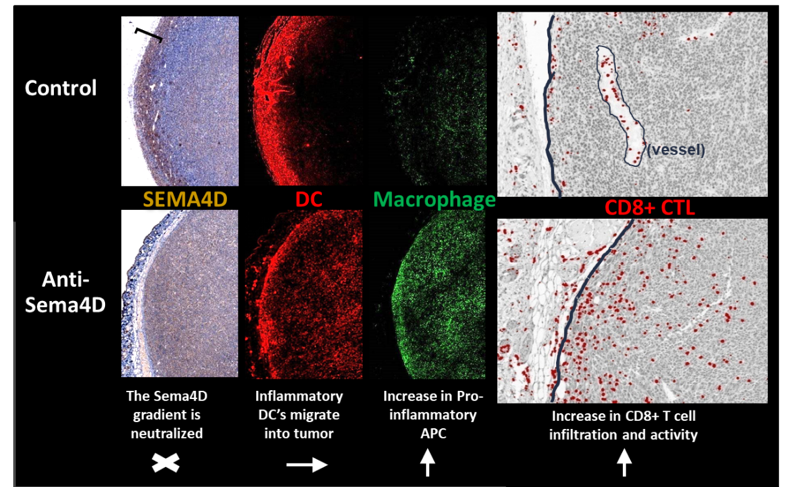
Semaphorin 4D (SEMA4D) is broadly expressed in many human cancers, and its expression correlates with invasive human disease. Preclinical studies have demonstrated that high concentrations of SEMA4D expressed at the invasive margin of tumors can immobilize immune cells and restrict infiltration into tumor. Antibodies against SEMA4D neutralize this barrier and “open the gates” of the tumor to the immune system. This facilitates anti-tumor immune responses and results in reduced tumor burden in animals.
First-in-class Immunotherapy for Cancer
Pepinemab is a novel monoclonal antibody that blocks the activity of SEMA4D.
Preclinical and early clinical data in melanoma suggest that antibody blockade of SEMA4D increases the number and maturity of immune cell aggregates called Tertiary Lymphoid Structures (TLS) within the tumor microenvironment. These TLS are correlated with greater tumor regression by functioning as an anti-tumor immune hub.

Immunohistochemistry showing a Tertiary Lymphoid Structure (TLS). Each color represents a different immune cell type.
Note: Pepinemab (VX15/2503) is an investigational drug currently in clinical studies. It has not been demonstrated to be safe and effective for any disease indication. There is no guarantee that pepinemab (VX15/2503) will be approved for the treatment of any disease by the U.S. Food and Drug Administration or by any other health authority worldwide.

Greengard, E. et al.
Pediatr Blood Cancer. 2024; 71
Evans E.E. et al.
Cancer Immunol Res. 2015 Jun;3(6): 689-701
SITC Nov 7, 2025
Neoadjuvant pepinemab enhances immune checkpoint blockade in metastatic melanoma
Presented by Crystal Mallow
AACR6007 April 25, 2025
Presented by E. Evans, Ph.D.
Keystone Oct 4, 2023
Presented by Crystal Mallow
ESMO Sept 13, 2022
Presented by Michael Lowe, M.D.
For detailed scientific information on SEMA4D and pepinemab in oncology, please see our publications, presentations and posters.
A Phase Ib/II Study of Pepinemab in Combination with Avelumab in Advanced Non–Small Cell Lung Cancer
Shafique, M.R. et al.
Clinical Cancer Research, 2021
Immunomodulation of the tumor microenvironment by neutralization of Semaphorin 4D
Evans, E.E. et al.
Invited “Author’s View”. OncoImmunology, 2015. 4:12
ASCO June 4, 2025
Presented by Conor E. Steuer M.D.
CICON Sept 10, 2024
Presented by Crystal Mallow
AACR PDAC Sept 27, 2023
Presented by Luis Ruffolo, M.D.
Corporate Presentation June 10, 2022
Pepinemab– Anti-SEMA4D Antibody for Cancer Immunotherapy
Presented by M. Zauderer, Ph.D.
Garg, S. et al.
Cell Reports 45, 117050. 2026
Clavijo, P.E. et al.
Cancer Immunol Res. 2019;7(2):282-291
Patnaik, A. et al.
Clin Cancer Res. 2016;22(4)
AACR8172 April 25, 2025
Presented by E. Evans, Ph.D.
ASCO June 1, 2024
Presented by E. Evans Ph.D.
SITC Nov 11, 2022
Presented by Brian Olson, Ph.D.
AACR April 11, 2022
Presented by T. Fisher, Ph.D.